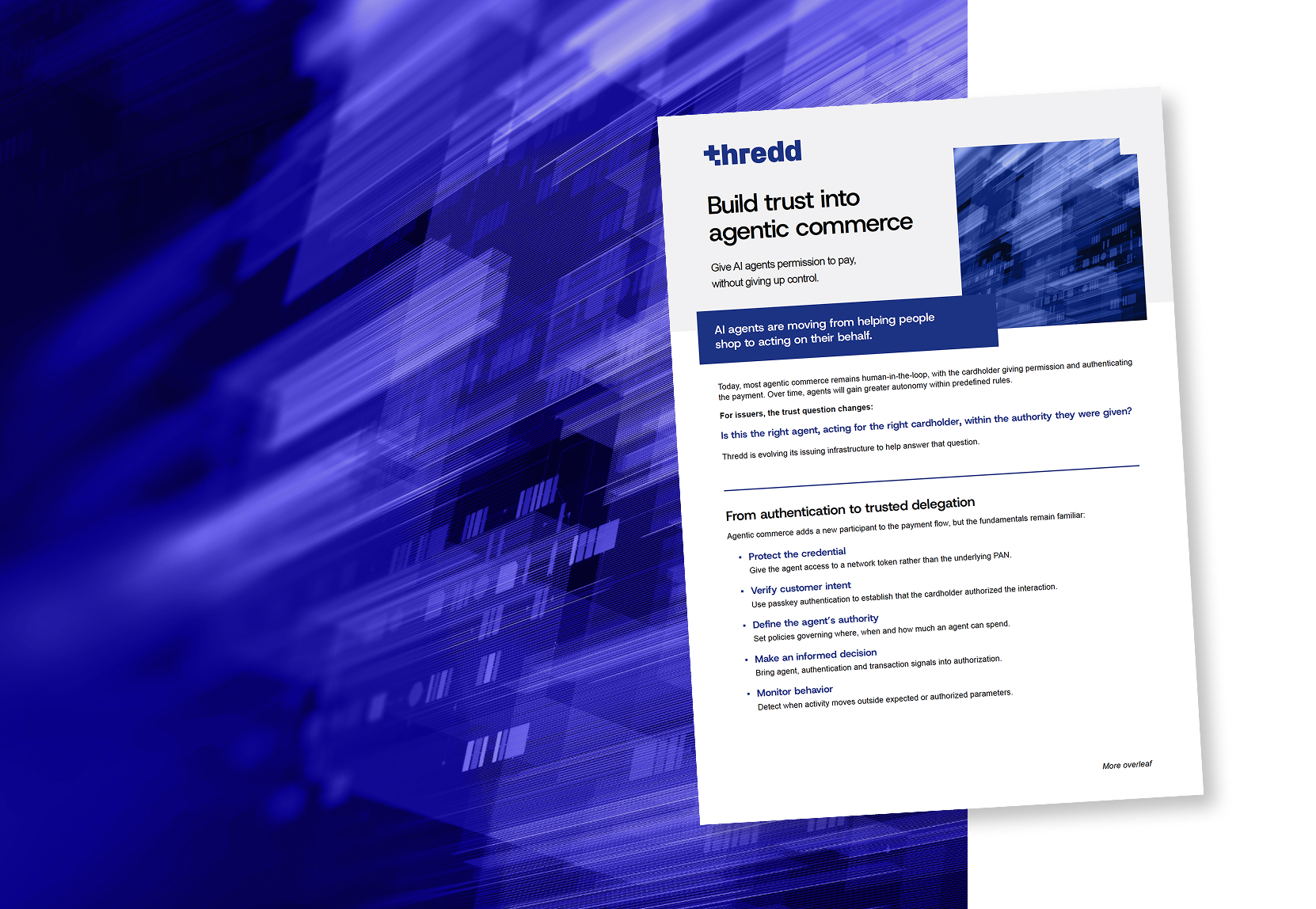
Build trust into agentic commerce
Our factsheet sets out how an agentic payment works from start to finish, what issuers need to control at each step, and the capabilities Thredd brings into the issuer processing environment to support it.

The question issuers have to answer is changing
AI agents are moving from helping people shop to acting on their behalf. Today, most agentic commerce keeps the cardholder in the loop, with the customer giving permission and authenticating the payment, and over time agents will gain more autonomy within rules the customer sets.
For issuers, that changes the trust question. Instead of only asking whether this is the real customer, they now need to ask whether this is the right agent, acting for the right cardholder, within the authority it was given.
See below for what issuers need to answer before an agent initiates a transaction.
Who is the agent acting for?
Identify the customer who owns each purchase decision
Confirm the agent is legitimate before it can pay
Hold trustworthy evidence of the customer's delegation
What is the agent allowed to do?
Set limits on amount, merchant, geography, and timing
Check every purchase against the customer's mandate
Make each decision within milliseconds of the transaction
How should fraud controls change?
Act at the point of transaction, before settlement
Treat an agent's velocity and timing in context
Check behaviour against what the customer authorised
When I think about where the value of programmable payments sits, it isn't necessarily with who mints the coins or writes the standards. It's with who pulls it all together at the point of transaction."

How Thredd is preparing issuers for agentic commerce

Provision
We're enabling approved agents to transact with network tokens, so they can pay without accessing the underlying card number.

Authenticate
We're using biometric passkeys and device binding to help confirm that the cardholder authorised the agent.

Control
We're building agentic transaction policies, such as spend limits and agent allow lists, so each issuer takes part on its own terms.

Monitor
We're making agentic signals available to fraud monitoring, so controls can spot when an agent moves beyond what was authorised.

Understand
We're making agent-initiated transactions visible in reporting and webhooks, so issuers can track adoption and refine their controls.

Scheme-aligned
Thredd has generated 75m+ wallet tokens, joined Visa's Agentic Ready programme, and was first to market with Mastercard Dynamic Interchange and Visa Cloud Connect.
Every processor claims AI
The foundations agentic commerce depends on already power AI across our platform today.
AI in production
Fraud monitoring uses real-time models to flag anomalies within each programme's configured rules.
Credit decisioning uses AI-informed risk assessment at authorisation, within rules the client sets, so AI supports the decision rather than replacing it.
AI-assisted development shortens delivery cycles and improves code quality.

Built on the right foundations
A real-time, immutable system of record
Event-level decisioning at defined points in the transaction
Programmable controls for each programme
Explainability and auditability built into the architecture
When the agent pays: Identity, trust and fraud in agent-initiated payments
Ryan Dew, our Chief Product Officer, was joined by Anthony Craufurd from Visa, Steve Rayko from Zilch, and Stuart Barclay from Velocity to discuss what is overhyped about agentic payments, what is new, and what issuers need to change first.
Prepare your programme for agentic commerce
Talk to our team about how agentic payments could work within your programme, or download the factsheet to share with your colleagues.


